
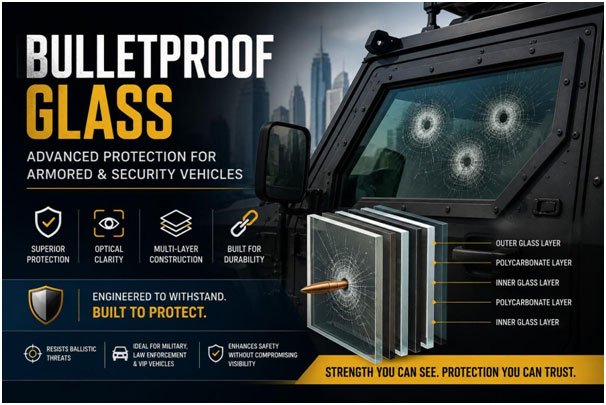
In today’s security-conscious environment, protecting people, assets, and vehicles from potential threats has become a top priority for government agencies, military organizations, law enforcement departments, and private security operators. One of the most critical components of any armored vehicle is bulletproof glass, a specialized transparent armor solution designed to provide visibility while delivering reliable ballistic protection.
Unlike standard automotive glass, bulletproof glass is engineered to withstand projectile impacts, reduce penetration risks, and enhance occupant safety. Modern advancements in materials and manufacturing have significantly improved the strength, clarity, and durability of bullet resistant glass, making it an essential component in a wide range of security and defense applications.
Bulletproof glass, commonly referred to as ballistic glass or bullet resistant glass, is a transparent protective material designed to resist penetration from bullets and other high-impact threats. While no glass is completely “bulletproof” under every condition, high-quality ballistic glass can effectively stop or slow projectiles depending on its protection level and construction.
The primary purpose of bulletproof glass is to provide a clear field of vision while maintaining a protective barrier between occupants and external threats. This makes it a critical component in armored vehicles, security facilities, government buildings, and military applications.
Modern bulletproof glass consists of multiple layers of specialized materials, including:
These materials work together to absorb and disperse the energy generated by ballistic impacts.
The manufacturing process involves combining several layers of glass and synthetic materials under controlled temperature and pressure conditions. This layered construction creates a transparent armor system capable of resisting significant impact forces.
Each layer serves a specific purpose. The outer glass layers help absorb the initial impact, while inner polycarbonate layers capture fragments and prevent penetration. The result is a highly durable structure that offers both protection and visibility.
Advanced manufacturing techniques ensure consistent thickness, optical clarity, and structural integrity throughout the glass panel.
The effectiveness of bulletproof glass depends on the quality and combination of its materials.
Most modern armored vehicle Parts glass systems utilize a combination of hardened glass and polycarbonate materials. Glass provides hardness and impact resistance, while polycarbonate offers flexibility and energy absorption.
This combination helps prevent spalling, which occurs when fragments break away from the inner surface after an impact. Reducing spalling is essential for protecting vehicle occupants from secondary injuries.
Ballistic glass is specifically engineered to handle various threat levels, including:
The level of protection depends on the thickness and design of the transparent armor system.
| Level | Typical Threat |
|---|---|
| NIJ IIIA | Handguns up to .44 Magnum |
| NIJ III | 7.62×51mm rifle rounds |
| NIJ IV | Armor-piercing rifle rounds |
EN 1063 uses ratings such as BR4, BR6, and BR7, with higher numbers indicating greater resistance to rifle threats.
Choosing the correct rating is critical. A system designed for handgun threats may not stop rifle ammunition.
The growing demand for armored transportation has increased the importance of high-performance bulletproof glass solutions.
The primary advantage of bulletproof glass is enhanced protection for passengers and vehicle operators. In high-risk environments, ballistic glass can significantly reduce the likelihood of injury during an attack.
Unlike solid armor plating, transparent armor allows occupants to maintain visibility without compromising security. Drivers can safely navigate while maintaining awareness of their surroundings.
Bullet resistant glass strengthens the overall security profile of an armored vehicle. Combined with armored doors, body panels, and reinforced structures, it forms an integrated protection system.
High-quality ballistic glass is designed to withstand harsh environmental conditions, including:
This durability makes it suitable for both civilian and military applications.
| Feature | Standard Laminated Glass | Bulletproof Glass |
|---|---|---|
| Stops bullets | No | Yes (rated threats) |
| Multiple layers | Limited | Yes |
| Polycarbonate core | Usually no | Often yes |
| Spall protection | Minimal | Engineered |
| Certified ballistic rating | No | Yes |
Ordinary laminated glass may reduce injury from accidental breakage, but it is not a substitute for certified ballistic glazing.
Bulletproof glass is widely used across multiple industries where protection and visibility are equally important.
Military vehicles often operate in challenging environments where personnel face elevated security risks. Transparent armor systems help protect soldiers while maintaining visibility during operations.
Common military applications include:
Police and law enforcement agencies frequently use armored vehicle Parts equipped with ballistic glass. These vehicles support:
Private security firms, corporate executives, diplomats, and high-profile individuals increasingly rely on armored transportation solutions. Bulletproof glass provides discreet protection while maintaining a professional appearance.
Ballistic glass is also installed in:
These installations help safeguard personnel and critical assets.
Not all bulletproof glass provides the same level of protection. Manufacturers design transparent armor systems according to recognized ballistic standards.
Choosing the correct protection level depends on several factors:
Higher protection levels generally require thicker materials and more advanced construction methods.
Organizations should carefully assess potential risks before selecting a ballistic glass solution.
Selecting the right bulletproof glass requires evaluating performance, durability, and compatibility with the intended application.
High-quality transparent armor should provide excellent visibility without distortion. Clear vision is critical for safe vehicle operation and effective situational awareness.
Bulletproof glass is significantly heavier than standard automotive glass. Manufacturers must balance protection requirements with vehicle performance and payload capacity.
The best ballistic glass systems resist:
These characteristics contribute to longer service life and reduced maintenance requirements.
Transparent armor should integrate seamlessly with other vehicle protection components, including:
A complete protection package ensures maximum effectiveness.
Proper maintenance helps preserve both the appearance and performance of bulletproof glass.
Regular inspections can identify early signs of wear, including scratches, edge damage, or delamination. Using approved cleaning products helps prevent surface deterioration and maintains optical clarity.
Vehicle operators should also follow manufacturer recommendations regarding handling, installation, and replacement schedules.
Routine maintenance contributes to consistent performance and extends the lifespan of the transparent armor system.
Security products should be selected based on documented testing, not marketing claims. Certified systems provide measurable protection against defined threats and help ensure consistent performance.
Reliable suppliers provide:
For professionally engineered armor and security components, exploreArmour Parts .
Bulletproof glass is a specialized transparent armor system designed to resist specific ballistic threats while preserving visibility. By combining multiple layers of glass and polymer materials, it absorbs projectile energy, reduces spall, and provides a critical protective barrier in armored vehicles, banks, embassies, and other secure environments.
The most important factors when selecting bulletproof glass are the required protection level, certification, weight, frame integration, and application environment. Whether the need is for an armored vehicle windshield or a secure building entrance, choosing a properly tested ballistic glazing system is essential for dependable protection.
Bulletproof glass is a multi-layered transparent material designed to resist bullets and reduce projectile penetration while maintaining visibility.
It absorbs and disperses the energy of a bullet through multiple layers of glass and polycarbonate, helping prevent penetration and minimizing glass fragments.
It is widely used in armored vehicles, banks, government buildings, embassies, military facilities, retail security counters, and other high-security locations.
No. It is more accurately called bullet-resistant glass because it is designed to withstand specific ballistic threats based on certified protection levels.
Select bulletproof glass based on the required threat level, certified ballistic standards, application, weight requirements, and compatibility with the installation frame.

Discover premium heavy duty tyres and rims for armored vehicles in UAE. Built for durability, run-flat perform...

Shop high-quality vehicle armour accessories in UAE including gun ports, bumpers, blackout lights, turret bear...